A Locus from Midpoints of a Rectangle
Problem
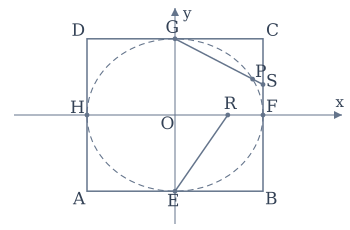
In the rectangle , and . Let be the midpoints of respectively, and let be the center of the rectangle. Set up coordinates with as the origin, the -axis along line and the -axis along line , so that
Moving points and lie on the lines and respectively and satisfy and for . The lines and intersect at .
1. Prove that lies on a fixed ellipse, and find the equation of this ellipse.
2. When , a line through (not coinciding with the -axis) meets the ellipse from part 1 at two points and . From drop a perpendicular to the line , with foot . Let the line meet the -axis at . Find the maximum area of .
Answer
Solution
| Difficulty | 8/10 |
|---|---|
| Topics | conic sections, analytic geometry |
Whiteboard
Your sketch is saved only in this browser. To share it, export your drawing as an image (whiteboard menu → Export as → PNG), then upload that image in the comments below.
Discussion
Ask questions, share alternate solutions, and use LaTeX freely.
No comments yet.