Surface Area and Volume of a Folded Hexagonal Solid
Problem
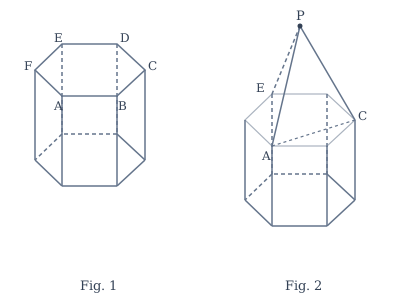
In a regular hexagonal prism (Fig. 1) the base edge length is and the lateral edge length is . Points are given by , , with . From the prism, cut away the three tetrahedra , , , then fold triangles , , upward through about , , respectively, so that coincide at a single point ; this yields the curved-top polyhedron in Fig. 2.
Let be the surface area and volume of the original prism, and let be the surface area and volume of the resulting polyhedron when . Determine, with justification, the relationship between and , and between and .
Answer
Solution
| Difficulty | 9/10 |
|---|---|
| Topics | solid geometry, Reflection, Symmetry, vectors |
Whiteboard
Your sketch is saved only in this browser. To share it, export your drawing as an image (whiteboard menu → Export as → PNG), then upload that image in the comments below.
Discussion
Ask questions, share alternate solutions, and use LaTeX freely.
No comments yet.