Curve Traced by a Sliding Linkage
Problem
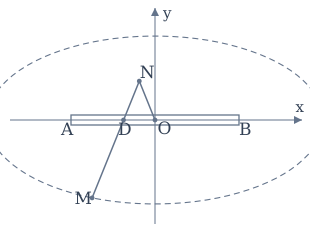
A drawing tool is built as follows. is the midpoint of a straight slot . A short rod can rotate about , and a long rod is joined to by a hinge at ; a pin on the rod can slide along the slot . The lengths satisfy and . As the pin moves back and forth inside the slot , the point makes one full revolution about (when is stationary, is also stationary). The tip of the long rod traces a curve . Take as the origin and the line as the -axis.
1. Find the equation of the curve .
2. A variable line meets the two fixed lines and at points and respectively. If always has exactly one common point with the curve , determine whether the area of attains a minimum value. If it does, find that minimum; if not, explain why.
Answer
Solution
| Difficulty | 7/10 |
|---|---|
| Topics | Parametrization, Affine Transformation, conic sections, AM-GM, analytic geometry |
Whiteboard
Your sketch is saved only in this browser. To share it, export your drawing as an image (whiteboard menu → Export as → PNG), then upload that image in the comments below.
Discussion
Ask questions, share alternate solutions, and use LaTeX freely.
No comments yet.